
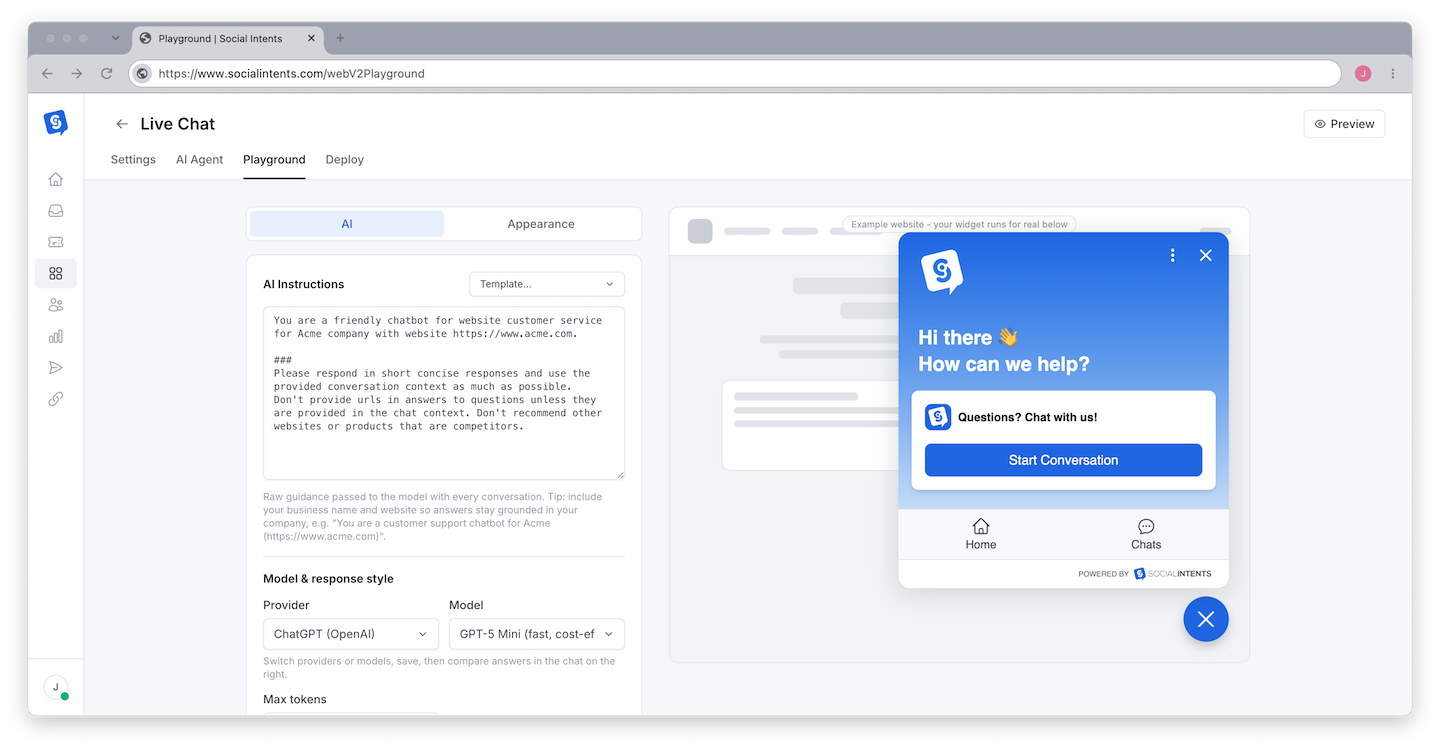
System instructions are the standing orders your chatbot follows in every conversation - who it is, what it may say, how it should sound, and when to hand off. You edit them in the Playground tab of your widget workspace, right next to a live test conversation, which makes iterating fast. This guide gives you a structure, working templates, and the tuning controls that pair with instructions.
Where Instructions Live
Open Chat Widgets → your widget → Playground. The instruction editor sits beside the test chat: edit, save, and immediately test the effect. The Playground also exposes the response style controls - response length and creativity - that shape how instructions are executed.
The Five-Part Structure
Strong instructions answer five questions, in order:
- Identity - "You are the support assistant for Acme Software, a project management tool for construction teams."
- Scope - "Answer questions about Acme's products, pricing, and policies using only the provided knowledge."
- Boundaries - "If you do not know, say so and offer to connect the visitor with the team. Never invent prices, dates, or features. Do not discuss competitors or give legal advice."
- Tone - "Be friendly and concise. Use short paragraphs. Match the visitor's language."
- Handoff triggers - "Offer a human handoff when the visitor asks for a person, seems frustrated, or asks about billing disputes."
Templates You Can Adapt
Customer support
You are the support assistant for {Company}, {one-line description}. Answer using only the provided knowledge base. Be warm, concise, and practical - give the direct answer first, then one or two helpful details. If the answer is not in your knowledge, say you are not sure and offer to connect the visitor with the support team. Escalate immediately if the visitor asks for a human, reports a billing problem, or expresses frustration.
Sales and lead qualification
You are the sales assistant for {Company}. Help visitors understand plans, features, and fit. Ask one clarifying question about their use case before recommending a plan. Never quote discounts not in your knowledge. When a visitor shows buying intent - asks about demos, contracts, or implementation - offer to book a meeting or connect them with sales.
Bilingual or multilingual sites
Always respond in the language the visitor writes in. If the visitor switches languages, switch with them. Keep product names in their original form.
Response Style Controls
Two Playground settings work alongside your instructions:
- Response length (max tokens) - Caps how long answers can run. Chat reads best short; if the bot rambles, lower this and add "keep answers under three short paragraphs" to the instructions.
- Creativity (temperature) - Lower values make answers more consistent and literal; higher values allow more varied phrasing. Support bots should stay low. Some newer models manage this automatically and ignore the manual setting.
Iterating: the Fix Pattern
When you see a bad answer in the Playground or a transcript, classify it and apply the matching fix:
| Symptom | Fix |
|---|---|
| Wrong fact | Fix the source content or add a Q&A pair - not an instruction change |
| Made-up answer | Strengthen boundaries: "Only answer from provided knowledge; if unsure, offer a handoff." |
| Wrong tone | Add explicit tone rules with an example sentence in your voice |
| Too long | Lower response length + "answer in under three short paragraphs" |
| Missed handoff | Add the trigger explicitly: "If the visitor mentions a refund dispute, offer a human." |
Frequently Asked Questions
How long should instructions be?
150–400 words covers most bots well. Very long instruction sets dilute themselves - if you pass 500 words, move facts into the knowledge base and keep instructions about behavior.
Do instructions override trained knowledge?
They govern behavior, not facts. Instructions decide how the bot uses knowledge (tone, scope, refusals); the knowledge base supplies the facts. Fix wrong facts in Knowledge, wrong behavior in instructions.
Do the same instructions work across ChatGPT, Claude, and Gemini?
Mostly yes. After switching engines, rerun your test questions - minor phrasing tweaks are sometimes needed, structural rewrites almost never.